

How Much Does Custom Software Development Cost in 2026?
“How much will it cost?” is the first question every business leader asks before starting a software project, and the hardest one to answer with a single number. A simple internal tool and a multi-tenant platform connected to an ERP are both “custom software”, yet their budgets can differ by a factor of ten.
This guide explains what custom software development costs in 2026, what actually drives the price, how pricing models compare, and how to estimate a realistic budget for your own project before you talk to a vendor.
Short answer: publicly available estimates for custom software projects typically start around $30,000 for a focused application and exceed $300,000 for complex enterprise platforms, with timelines from about four months to more than a year. The real figure depends on scope, integrations, team location and the level of quality and security you require.
Typical cost ranges for custom software
Vendors rarely publish prices, but some do give orders of magnitude. Appinventiv, for example, states on its French market page that custom software typically costs “$30,000 – $300,000 or more”, with delivery in roughly 4 months to 1 year or more, and groups budgets into four brackets: under $50K, $50K–$100K, $100K–$250K and over $250K.
These brackets are a useful starting point. In practice, projects tend to fall into one of these profiles:
- Focused tool or MVP: one core workflow, a limited number of screens, few integrations. Usually the lowest bracket. Read our guide to the Minimum Viable Product (MVP) to see how to start small.
- Business application: several user roles, a back office, reporting and one or two integrations (CRM, payment, email). Typically the middle brackets.
- Enterprise platform: many modules, complex business rules, high availability, integrations with ERP or legacy systems, strict security and compliance. Upper brackets and beyond.
Treat any published range as an indication only. The only reliable number is the one produced from your scope.
What drives the cost of custom software?
Six factors explain most of the difference between two quotes.
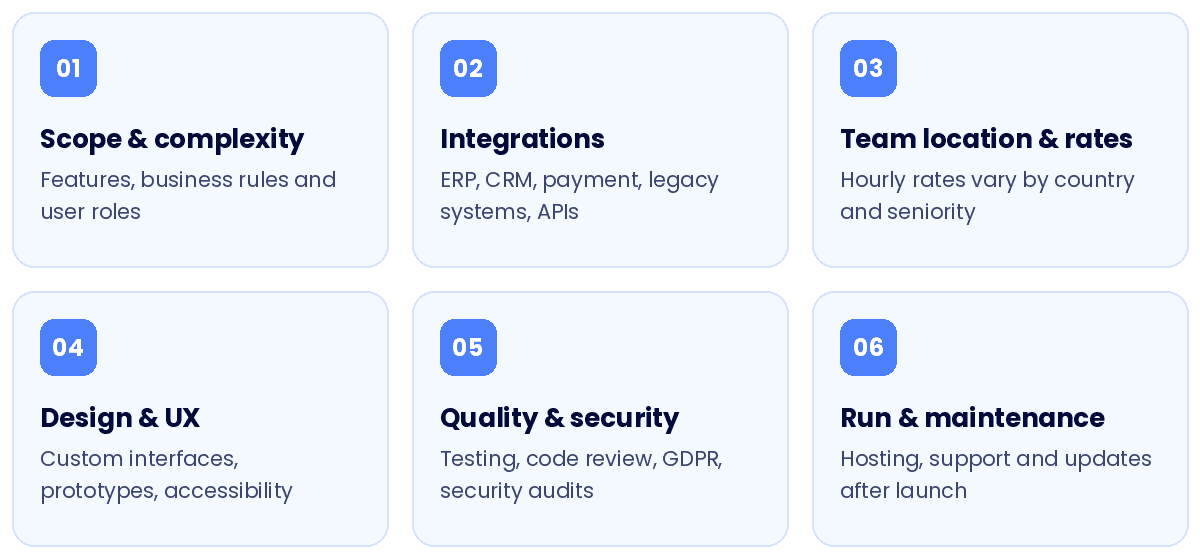
1. Scope and complexity
The number of features matters less than their complexity. A screen that displays data is cheap; a pricing engine with dozens of business rules, approval workflows and exceptions is not. Every user role, every status and every edge case adds design, development and testing time.
2. Integrations
Connecting your software to an ERP, a CRM, a payment provider or an ageing in-house system is often where budgets slip. Well-documented APIs are quick to integrate; undocumented legacy databases require analysis, data mapping and extra testing. If your project involves an older system, our legacy application modernization services page explains how we handle it.
3. Team location and hourly rates
Rates vary widely by country, seniority and company size. On Clutch’s directory of software developers serving Paris, listed companies show hourly rates ranging from under $25 to $100–$149, and minimum project sizes from $1,000+ to $25,000+. A lower rate does not automatically mean a lower total: productivity, communication and rework all affect the final bill.
4. Design and user experience
Using a standard component library is faster than designing a fully custom interface. Workshops, prototypes and user testing add upfront cost but reduce expensive changes later.
5. Quality, security and compliance
Unit tests, automated tests, code reviews and security audits are not optional extras; they determine how much the software will cost to maintain. Projects that handle personal data in Europe must also be designed for GDPR from day one. Our Agile Scrum development methodology builds testing and code review into every sprint for this reason.
6. Hosting, support and maintenance
The launch is not the end of the budget. Hosting, monitoring, security updates, bug fixes and new features continue for the life of the product. Plan for it from the start with a software maintenance plan.
Cost breakdown by project phase
Budgets are easier to understand when split by phase. The share of each phase varies by project, but every serious estimate should cover:
| Phase | What it includes | Why it matters for cost |
|---|---|---|
| Discovery & requirements | Workshops, user stories, scope definition | The cheapest phase to change your mind |
| UX/UI design | Wireframes, mockups, prototype | Validates usability before code is written |
| Architecture | Tech stack, data model, integrations | Determines scalability and future costs |
| Development | Front end, back end, APIs, in Agile sprints | Usually the largest share of the budget |
| Testing & QA | Unit, integration, acceptance, automated tests | Prevents costly bugs in production |
| Deployment | CI/CD, environments, go-live | Makes releases repeatable and safe |
| Maintenance | Support, updates, evolutions | Recurring cost after launch |
For a step-by-step view of these phases, see our guide to the custom software development process.
Fixed price or time and materials?
The pricing model changes how risk is shared between you and your provider.
- Fixed price: one price for a precisely defined scope. Predictable, but any change requires a new quote, and vendors add a risk margin to cover uncertainty. Best for small, well-specified projects.
- Time and materials: you pay for the time actually spent. Flexible and well suited to Agile delivery, where priorities evolve sprint after sprint. Requires transparent reporting.
- Dedicated team: a team reserved for your product over several months, billed monthly. Best for long-term products with a continuous roadmap.
Many projects combine models: a fixed-price discovery phase, then time and materials for development.
How to estimate your own budget
You can build a first estimate in five steps:
- List the user roles and key workflows (for example: “a sales rep creates a quote, a manager approves it”).
- Break each workflow into user stories and identify the integrations involved.
- Estimate effort for each story with your provider, in days or story points.
- Multiply by the blended daily rate of the team, then add time for testing, project management and deployment.
- Add a contingency for unknowns and plan the yearly maintenance budget separately.
Illustrative example only: a project estimated at 200 developer-days, delivered by a team with a blended rate of $500 per day, represents $100,000 of development effort before contingency and maintenance. Change the number of days or the rate and the total moves proportionally, which is why a precise scope matters more than any average.
How to reduce costs without cutting quality
- Start with an MVP and add features based on real user feedback.
- Prioritize the backlog ruthlessly: build what creates value first.
- Reuse proven components and standard services (authentication, payments, notifications) instead of reinventing them.
- Invest in a discovery phase: clarifying requirements early is far cheaper than changing code later.
- Automate testing and deployment to keep each release fast and safe.
- Choose a partner who reports transparently on progress, velocity and quality at every sprint.
Frequently asked questions
How much does custom software cost on average?
There is no meaningful average because scopes differ so much. Published estimates commonly range from about $30,000 for a focused application to more than $300,000 for complex platforms. A scoped estimate from your requirements is the only reliable figure.
How long does it take to build custom software?
Publicly quoted timelines range from about four months to more than a year. An MVP can often be delivered faster, then extended sprint by sprint.
Is custom software more expensive than off-the-shelf software?
The upfront cost is usually higher, but custom software has no per-user licence fees, fits your processes exactly and belongs to you. Over several years, the total cost of ownership can be lower, especially when off-the-shelf tools require heavy customization.
What is not included in a development quote?
Check whether hosting, third-party licences, maintenance, security audits and future evolutions are included. These recurring costs should be part of your budget from the start.
Need a realistic estimate for your project? Euro Tech Conseil, a Paris-based custom software development company since 2000, delivers custom software development services with transparent Agile reporting. Contact our team to discuss your scope and budget.
Sources: Appinventiv, “Software Development Services in France” (appinventiv.com); Clutch, “Top Software Developers in Paris” (clutch.co), consulted November 2026.